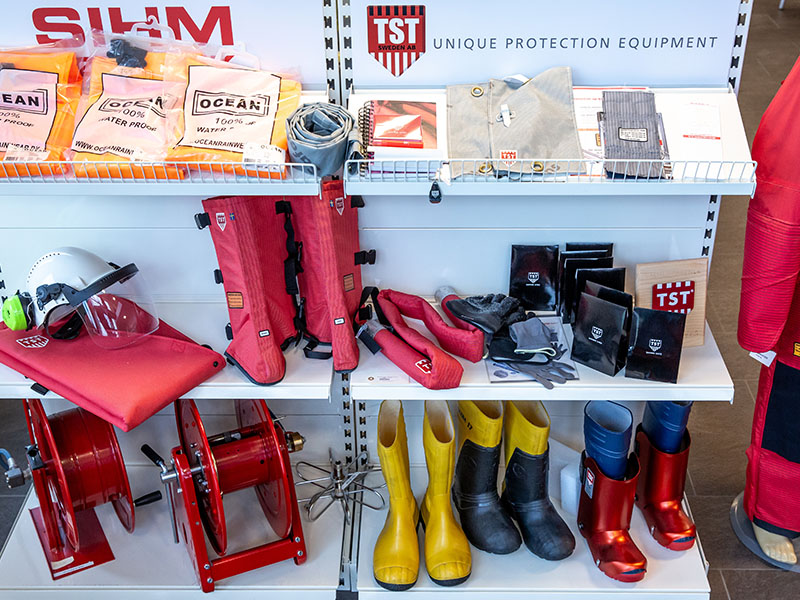
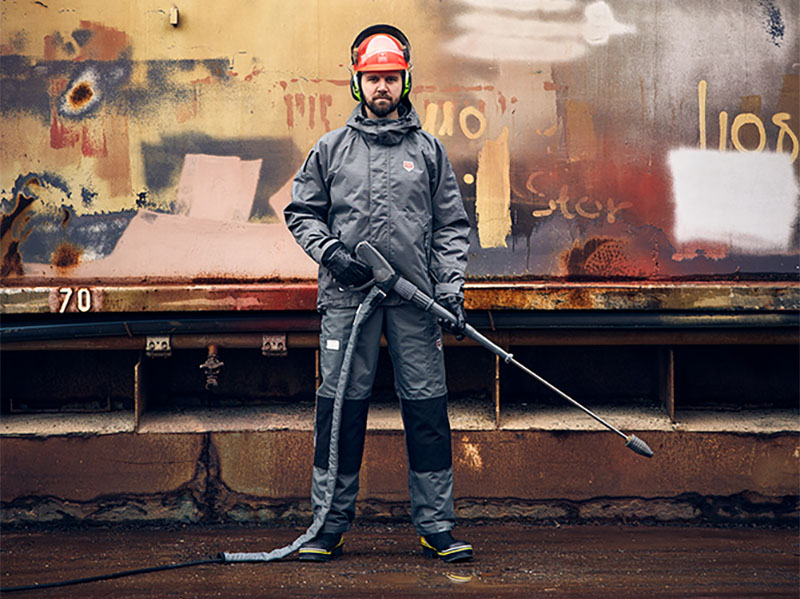
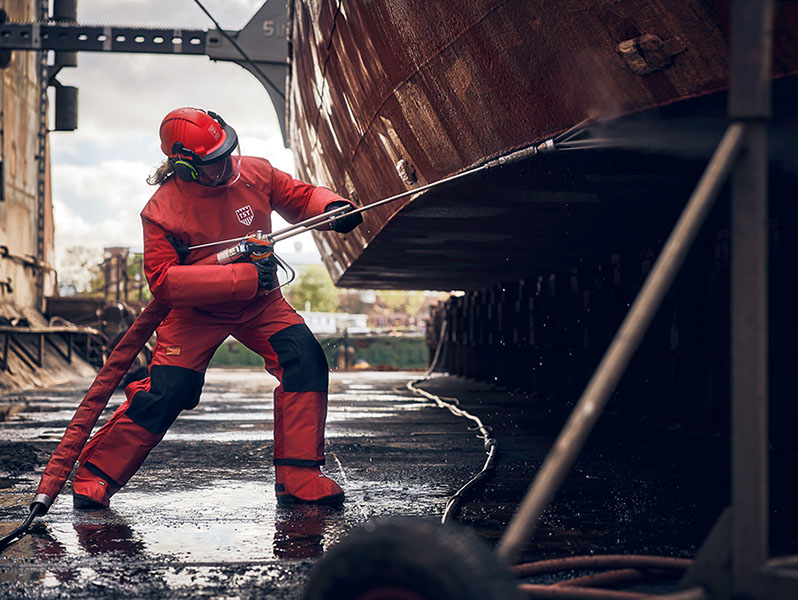
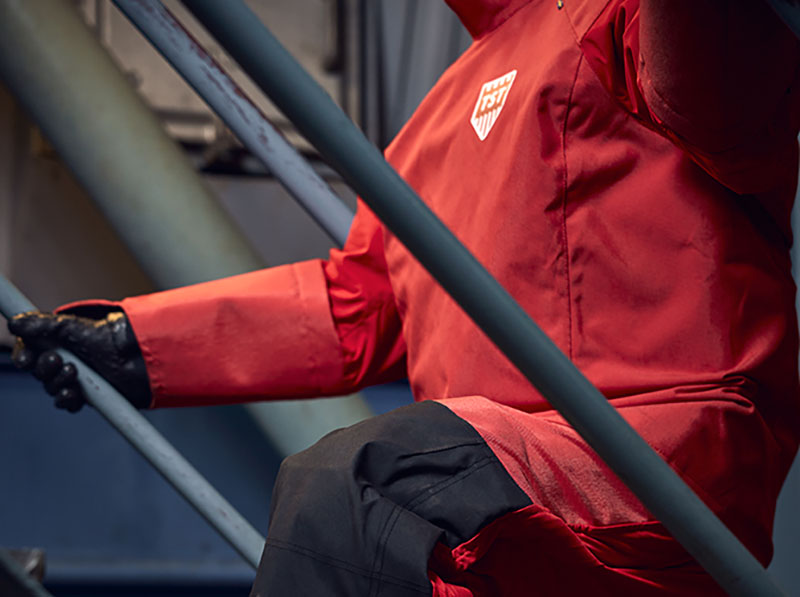
High-pressure is used for cutting, cleanings and grinding on all hard surfaces. If you, as a person, are hit by a water jet, there is a significant risk of severe damage. The damage can be far worse than what initially meets the eye. Therefore Sihm Højtryk A/S recommend that you always where appropriate PPE when workig with high-pressure.
Personal Protective Equipment are often refered to as PPE, and this is also the term that we will be using in the following
At Sihm Højtryk we distribute PPE from both TST Sweden® og TurtleSkin®.
Should you or a colleague accidentially be hit by a high-pressure jet, seek medical care immediately. What appears to be an innocent looking cut or bruise can be far more serious than one might initially assume – there is a reason that the EU regulation covering this area compares it with a gunshot wound.
Under Downloads an instruction for medical personnel can be found, emphasizing areas of importance when dealing with high-pressure injuries. You are welcome to refer to this document if necessary.
For further information contact our sales department, they are happy to hep you define and combine the ideal PPE solution to your needs.
There is no one clear set of rules stating which PPE should be used when working with high-pressure.
Previously this area was covered by the Danish Working Environment Authories, in what was called D.2.20, which has been discontinued. In Denmark and the rest of the EU, you should follow the EU2016/425, which is the general regulation stipulating PPE requirements.
The regulation states the requirements for choice, use and maintenance of PPE. For PPE requirements / options the following documents must also be consulted;
See hereunder for a brief run-through of the regulation and standards from a high-pressure point of view.
Operator must be equipped with PPE designed for the operating pressure.
It is important to asses the entire regulation in relation to PPE, hereunder the development of water vaporization / aerosols etc., which can be developed during high-pressure use – this should be incorporated to the risk assessment.
The reposibility of correct PPE lies with:
Role | Responsibility |
Developer / Contractor | Must ensure suitable PPE is available and that it is used during work |
Employer / Owner of high-pressure equipment | Must supply suitable PPE. PPE must be intact and clean |
Operator | Must use supplied PPE during work and ensure that the PPE is intact and cleaned after use. . |
The Regulation excempts machines under 200 bar, as it is presumed that regular working clothes will provide suitable proteciton for this group of machines.
(High-pressure Units)
Covers safety requirements for design, construction and use of machines with working pressure above 250 bar.
EN 1829-1 does not have a specific definition of which PPE should be used. The risk assessment of the machine should cover this as well as cover the risks that cannot be eliminated by means of constructional or design measures. (Technical or organizational measures).
The manufacturer’s risk assessment concerning PPE must be stated in the User Manual.
Ultimately it is the manufacturer user manual that stipulates the minimum requirements which must be met when working with the specific high pressure unit / equipment.
The standard applies to pressure from 250 bar and there is therefore a pressure range from 200 to 250 bar that is not regulated. It is recommended to always consult the manufacturer user manual and follow the EU Regulation.
(High-pressure Units – Safety Requirements – Part 2: Hoses, hose lines and hose connections)
Covers safety requirements for high-pressure hoses, hose lines and connections with focus on e.g. correct assembly, pressure and condition.
So how does that translate into practise?
NOTE! Pay attention to any local rules / precautions for the job site.
Can the job be performed without the direct presence of operator? (Technical and organizational measures)
If not, the level of PPE must be defined
This defines the extent of the high-pressure PPE
Especially if connections are close the operators body, there might be a need for a hose protection to cover the connection
NOTE! The above is to be considered as a guide only. Sihm Højtryk A/S cannot be held liable, as the assesment must be made on the basis of the current work situation.
When the risk assessment are completed and the requirements of the user manual has been assessed, the appropriate PPE can be determined. Depending on what is stated in the user manual, starting point must be taken in the working pressure, working position, working method and risk of direct or in-direct contact with the high-pressure jet.
Safety clothing developed specifically to withstand a high-pressure jet is available for various pressure ratings – so first step is to define which PPE is available for the working pressure.
At Sihm Højtryk we are happy to help you find a solution that is suitable for the job at hand. To assist you, we have tried to make a simple overview of which options are available, that can be used as guide / inspiration.
For work performed in an up-right standing position – typically work with high-pressure gun, where the operator does not need to crawl, kneel, etc. – an apron might be a solution.
For more options, contact our sales department.
Does the job, however, require the operator to kneel, crawl or in any other way work in more extreme positions, one might look at an option that offers more protection than that of an apron.
State working pressure when forwarding your enquiry, to make sure that the solution matches the actual pressure.
PPE must be chosen based on the risk assessment and the manufacturer user manual. Sihm Højtryk recommends that the operator always wears PPE, that as minimum is approved for the working pressure.
Up to 500 bar (ProOperator)
Up to 2000 bar (UltraOperator)
Up to 2800 bar (10/28)
Up to 3000 bar (EliteOperator)
Hereunder our suggestion as to how a safety package could be put together, depending on the task, which can be used as inspiration (Danish only)
You are working with an automated robot solution. In the risk assessment it is determined that there is no need for the operator to wear high-pressure PPE, as the operator will be located 10-15 meters away form the actual high-pressure work place.
During the work the operator is positioned next to the high-pressure hose, connecting the high-pressure unit and the robot, when the hose suddenly bursts and the operator is hit by the water jet with for example 1800 bar.
The authorities are informed and they conclude that despite of the presented risk assessment and that technical measures have been made, the risk assessment have not been adequate, as an accident has occured.
They will consult the manufacturer user manual and here it may say that the operator must wear jacket and trousers designed for the working pressure. So despite the fact that the operator was not in direct contact with the high-pressure work place, the wording of the manual would, in case of an accident, weigh more than the risk assessment and it might be concluded that the owner has not taken the necessary measures according to the regulation and standards.
Above only to illustrate the importance of consulting the user manual and consider all scanarios. The accident might have been avoided by taking out the hose from use in connection with the daily visual inspektion of hose, connection, etc., re-routing the hose, and so on.
This example is only to underline that in case of an accident it is the working of the manufacturer user manual that overrules everything else.